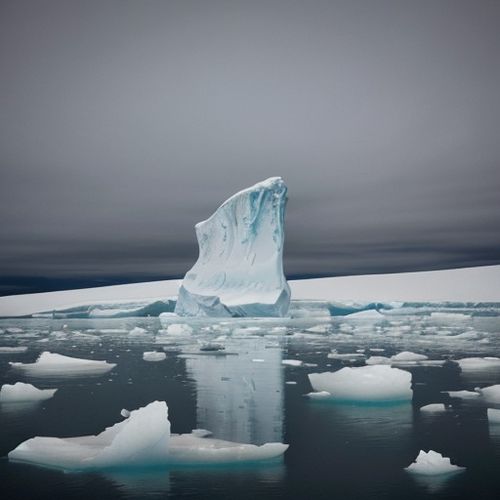
The haunting symphony of melting ice in Antarctica has found an unexpected audience far beyond the scientific community. A team of glaciologists and sound artists recently collaborated to transform raw hydrophone recordings from beneath the ice shelves into a startling environmental album titled "Antarctic Elegy: The Sound of Disappearing Worlds." This unconventional project bridges art and science to deliver what may be the most visceral climate change warning ever recorded.
Beneath the crystalline surface of Antarctica's glaciers, a hidden orchestra performs day and night. As freshwater from melting ice percolates through crevasses, it generates eerie pops, groans, and resonant frequencies that travel through the ice like subterranean church bells. These sounds, captured by researchers monitoring ice shelf stability, reveal an acoustic fingerprint of climate collapse. The album's lead track features the Ross Ice Shelf's distinctive "plink-plonk" meltwater sounds accelerating over a 72-hour recording period – an audible representation of rising temperatures.
Dr. Eleanor Voss, the glaciologist who spearheaded the recording project, describes the experience of first hearing these sounds through hydrophones: "We expected creaking from ice movement, but the meltwater created something closer to avant-garde jazz – unpredictable percussive bursts followed by sustained low tones that vibrated through our equipment." The team soon realized these sounds contained valuable data about melt rates and ice fracturing patterns, encoded in frequencies ranging from 20 Hz to over 12 kHz.
The artistic transformation of these recordings involved minimal manipulation. Sound designer Markus Yi applied subtle spatialization to recreate the immense scale of ice cavities, allowing listeners to experience the sounds as if floating inside glacial tunnels. One particularly chilling segment layers recordings from the same location across three decades, demonstrating how meltwater sounds have increased in both volume and complexity as warming intensifies.
Environmental psychologists studying the album's impact report extraordinary results. Unlike statistical data or photographic evidence of ice loss, the auditory approach triggers deeper emotional responses. Test subjects displayed increased activity in brain regions associated with empathy and long-term memory when listening to the ice sounds compared to viewing climate change visuals. The album's most powerful moment comes during the 18-minute "Calving Event" track, which documents the seismic audio signature of a Manhattan-sized ice chunk breaking away from the continent.
Beyond its artistic merit, the project serves practical scientific purposes. The team developed an algorithm that can estimate real-time melt rates from audio characteristics alone, potentially creating an early warning system for vulnerable ice shelves. This sonic monitoring approach proves particularly valuable during the Antarctic winter when visual observations become impossible. Researchers have already identified previously unknown meltwater channels beneath the Thwaites Glacier by analyzing unexpected acoustic reflections in the recordings.
The album's release coincides with growing interest in "environmental sonification" – converting ecological data into audible formats. Similar projects have transformed deforestation rates into shifting musical harmonies and carbon dioxide concentrations into dissonant string arrangements. Yet the Antarctic recordings stand apart because they require no artificial translation; the ice itself serves as both instrument and composer. As Dr. Voss notes, "We're not creating metaphors here – these are the actual voices of ecosystems in distress."
Critics initially questioned whether aestheticizing climate data might dilute its urgency, but the opposite appears true. The album's Bandcamp page includes commenters describing physical reactions to the sounds – tightness in chests, spontaneous tears, even reports of listeners developing frostbite-like tingling in their fingers. A museum installation featuring the recordings caused visitors to speak in whispers, as if standing in some vast frozen cathedral of sound.
Perhaps most remarkably, the project has reached audiences typically disengaged from environmental issues. Electronic music communities have embraced certain tracks for their organic textures, while meditation groups use the recordings' natural rhythms. This unexpected crossover has sparked collaborations between climate scientists and audio engineers working on immersive experiences. Next year will see the launch of an underwater hydrophone array designed to stream real-time Antarctic soundscapes to listening stations worldwide.
As the album continues to circulate, its creators hope the sounds will linger in listeners' minds longer than any statistic or speech. There's something uniquely haunting about hearing the Antarctic's transformation – not as abstract data, but as a chorus of pops, cracks, and groans forming an unintentional requiem. In making climate change audible, the project achieves what years of reports could not: making the distant Antarctic feel heartbreakingly present, and its loss unmistakably real.
By Emily Johnson/Apr 14, 2025
By Laura Wilson/Apr 14, 2025
By Sophia Lewis/Apr 14, 2025
By Olivia Reed/Apr 14, 2025
By Amanda Phillips/Apr 14, 2025
By Victoria Gonzalez/Apr 14, 2025
By Samuel Cooper/Apr 14, 2025
By Thomas Roberts/Apr 14, 2025
By Jessica Lee/Apr 14, 2025
By Noah Bell/Apr 14, 2025
By Ryan Martin/Apr 14, 2025

By John Smith/Apr 14, 2025
By Lily Simpson/Apr 14, 2025
By William Miller/Apr 14, 2025
By Eric Ward/Apr 14, 2025
By Megan Clark/Apr 14, 2025
By Ryan Martin/Apr 14, 2025
By Noah Bell/Apr 14, 2025
By Lily Simpson/Apr 14, 2025
By Sarah Davis/Apr 14, 2025